
Soccer’s World Cup tournament starts on Thursday. There’s a lot not to like about this edition, from the bloated size, absurd ticket prices, and ludicrous pandering. But I’m still going to watch. And, me being me, I’m going to crunch a few numbers regarding the new format of this year’s tournament.
The previous seven tournaments (1998 – 2022) all used the same format. Thirty-two teams were divided into eight groups of four. Each group played round robin matches, and the winner and second place team in each group advanced to the knockout rounds (sixteen teams total). From then on it was a straight elimination tournament. The bracket matchups were defined ahead of time (e.g., the winner of Group A plays the second place team in Group B, etc.).
This time there are forty-eight teams. The groups still consist of four teams, thus there are twelve round-robin groups instead of eight. At the end of group play, 32 teams advance to the knockout rounds: the group winners and second place teams, plus eight of the twelve third-place teams, based on how well they did in the group phase.
The inclusion of 3rd place teams makes the bracket assignments more complicated. Some of the matchups involve group winners or second place teams playing each other, as in previous years. But others pair up a 3rd place team with a group winner. The specific matchups depend on which eight of the third-place teams qualify. There are in fact 495 different ways that 8 teams can be selected from 12 possibilities (the combination of 12 items taken 8 at a time). FIFA has a 495-element table that defines who plays who, depending on which groups the eight third place teams come from.
How likely is it that the favored teams will advance to the knockouts? The round robin phase is brief (three games per team), so one slipup can put a team in jeopardy. But the new format makes it more likely that the top teams will advance, for two reasons. First, with 48 teams the overall strength of each group is lower, simply because there are more low-quality teams. Second, unlike previous tournaments a team can finish third and still advance. So teams like Argentina and Spain should in theory have no problem moving on. This hasn’t always been the case. In recent World Cups there have consistently been shock group-round exits of highly-seeded teams. In fact it averages one per tournament. These are the Pot One teams (highest seeds) that have been knocked out in the group phase (excluding host nations, who are always seeded in Pot One but are often weaker teams):
- 2022: Belgium
- 2018: Germany (previous champion)
- 2014: Spain (previous champion)
- 2010: Italy (previous champion)
- 2006: none
- 2002: France (previous champion), Argentina
- 1998: Spain
Will this pattern continue this year? Here are the seeded teams, and their probability of advancing to the knockouts (I’ll use Nate Silver’s World Cup Forecast for these numbers). I exclude the three host nations (USA, Mexico, Canada), as they are seeded not because of their quality, but because of tradition.
| Seeded Team | Probability of reaching knockout round |
| Spain | 0.99 |
| Argentina | 0.99 |
| France | 0.96 |
| England | 0.98 |
| Brazil | 0.97 |
| Portugal | 0.95 |
| Netherlands | 0.93 |
| Belgium | 0.96 |
| Germany | 0.98 |
The odds that all nine of these teams make it to the next round is simply the product of all of these probabilities. Which turns out to be…0.75, or 75%. So it’s most likely that there won’t be any shock exits, but it still could happen.
This tournament introduces another elimination round: the Round of 32. Previously the knockouts started with 16 teams, but now they start with 32. Not only does this extend the length of the tournament, it increases the chance of a top-notch team getting bounced via an upset. Sure it’s unlikely that, for example, Tunisia will knock France out of the tournament in a Round of 32 match. But chance of this happening is greater than zero, which is what the odds were in previous tournaments, simply because there was no Round of 32. You can’t lose a game you don’t have to play. This year, France (and Spain and Argentina and Germany) will have to play in those rounds, and they just might get bounced.
There’s another thing about the Round of 32 – there’s a reasonable chance of two top-notch teams meeting in it. FIFA sets up the bracket to avoid great teams playing against each other too early in the elimination rounds. But that relies on the good teams winning their groups. In a short round-robin phase (3 games), one slipup can send a team into second or third place. And suddenly a “clash of titans” match that you would expect to see in the quarterfinals or semis (or even the final) is happening in the Round of 32. Here are some probabilities (again, using the Silver’s World Up Forecast):
- Spain vs. Argentina: 29%
- England vs. Portugal: 17%
- Germany vs. France: 9%
- Brazil vs. Netherlands: 31%
You wouldn’t be out of line in predicting Spain vs. Argentina as the Final, and yet it could happen in the first round of knockouts! The odds of at least one of these four matchups happening is 63%. Don’t be surprised.
Finally, I’m interested in how the final slate of round robin games play out. One of the fascinating times of the tournament occurs after each team has played two games in the group stage. Everyone has one match left to determine who gets to the knockouts. At this point, teams are in one of five states:
| Status | Advancing to knockouts? | Something to play for (in 3rd group game) |
| Clinched first place in group | Yes | No |
| Clinched at least second place | Yes | Yes |
| Clinched at least third place advancement | Yes | Yes |
| Neither clinched nor eliminated | Maybe | YES! |
| Eliminated | No | No |
Teams that have clinched first place in their group have nothing to play for – win, lose, or draw they cannot change their position. So they might as well give their starters a rest. The next two categories are assured of advancing, but they could improve their position in the group standings, which would change their seeding in the knockout bracket. The “still in the hunt” teams (neither clinched nor eliminated) have everything to play for – the result of their match (and possibly the other match in their group) will determine if they advance. Finally, eliminated teams are just playing for pride and/or fun.
So with this new format, how often will these states happen? To answer this, I couldn’t use the Nate Silver’s World Cup Forecast because it doesn’t provide the granular detail I require. So I wrote my own simulator. It’s very simple, using the World Football ELO Ratings as a stand-in for team strength. The simulator “plays” each game of the tournament, with the winner determined randomly based on relative ELO ratings. I did a Monte Carlo simulation, playing 10,000 tournaments. Even though my simulator is extremely straightforward, it’s results are reasonably close to a couple of benchmarks: the odds at DraftKings sportsbook, and Silver’s World Cup Forecast. For comparison, here are the probabilities for a subset of teams, for both winning their group and making the semifinals.
| Win Group | Make Semis | |||||
| Sportsbook | Silver | My Sim | Sportsbook | Silver | My Sim | |
| Spain | 83.3% | 73.0% | 88.2% | 50.0% | 45.3% | 62.8% |
| France | 70.5% | 53.0% | 68.8% | 43.5% | 34.7% | 53.1% |
| England | 77.3% | 71.0% | 62.3% | 41.7% | 31.5% | 23.3% |
| Brazil | 82.6% | 64.0% | 70.4% | 35.7% | 25.3% | 25.9% |
| Colombia | 29.4% | 45.0% | 45.5% | 12.5% | 18.6% | 14.5% |
| Japan | 25.0% | 31.0% | 36.6% | 9.1% | 6.3% | 9.8% |
| Senegal | 10.5% | 14.0% | 12.5% | 5.6% | 6.0% | 6.1% |
What I’m trying to show here is that the simulation produces reasonable results. It’s not the best simulation, but it’s in the ballpark, and good enough for my intent, which is to analyze broad trends in the tournament. In this case, I want to see where things stand after all teams have played two games. Here are the averages of the 10,000 simulations:
| Scenario | # of teams (of 48) |
| Clinched 1st place | 2.2 |
| Clinched at least second place | 8.6 |
| Clinched at least 3rd place advancement | 2.1 |
| Neither clinched nor eliminated (still in the hunt) | 33.3 |
| Eliminated | 1.8 |
Bottom line: A vast majority of teams will have something to play for in the final round of group games. On average 33 teams will need a good result to move on, while another eleven will have clinched but may be looking to improve their standing. On average, only four will have nothing to play for (either locked into first or last place). That should make an exciting final four days of group play.
As those days proceed, the numbers change. Here’s a chart that shows the progression as the final matches for each group are played. As each group finishes up, more and more teams qualify for the next round, or are eliminated.
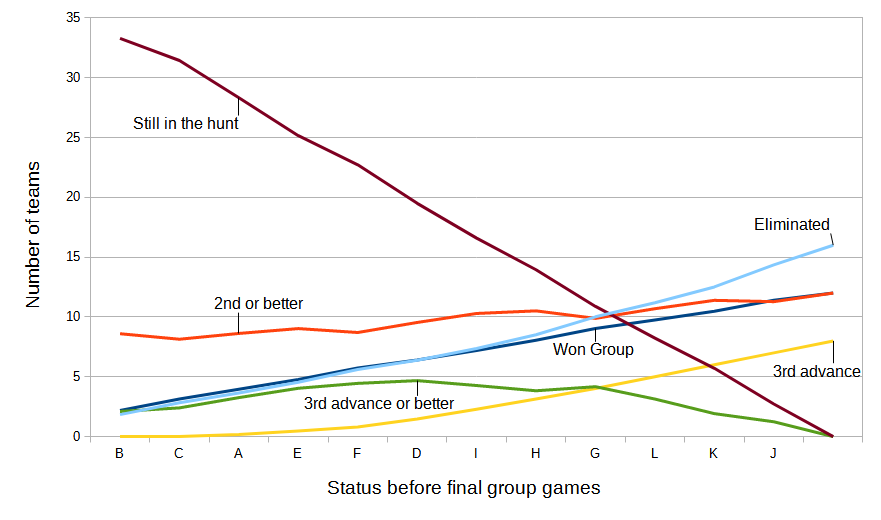
And then the fun really begins, with the knockout bracket. Spain vs Argentina in the Round of 32, anyone?
