
Each year the Census Bureau’s American Community Survey queries a subset of Americans about their housing status. One of the questions is how long the respondent has lived in their current residence. This is done for both owners and renters; for now, I’ll look at owners.
The question asks, effectively, “when did you move into your current home?” The results are reported in two ways: 1) the median year reported for a given population, and 2) a distribution by ranges of years. I’ll be using the most recent 5-year ACS survey, which is a collection of ACS yearly surveys, 2019-2023 (I use the 5-year survey to reduce the margins of error, especially when looking at smaller geographies).
Here are the results for the country as a whole:
1) Median year homeowner moved In: 2009.
2) Distribution of move-in year:
| Year Homeowner Moved In | Count | Percentage of Population |
| Moved in 2021 or later | 12,696,549 | 5.8% |
| Moved in 2018 to 2020 | 35,939,033 | 16.3% |
| Moved in 2010 to 2017 | 67,583,554 | 30.7% |
| Moved in 2000 to 2009 | 51,188,430 | 23.3% |
| Moved in 1990 to 1999 | 28,008,318 | 12.7% |
| Moved in 1989 or earlier | 24,531,313 | 11.2% |
Let’s look at the state level. This map shows the median year of move in for homeowners in each state. The darker the green, the more recent the average move-in date.
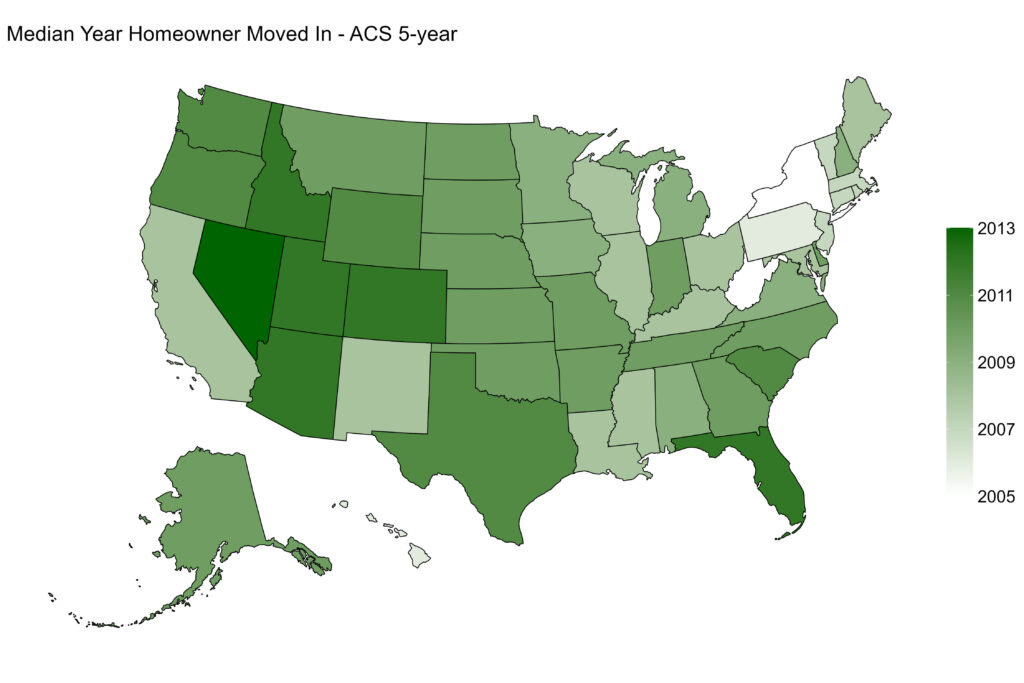
It’s not surprising that Nevada (followed by some other mountain states, plus Florida) has he latest move-ins. These states are growing; an influx of new residents means more recent home buyers. At the other end of the spectrum: New York and West Virginia. Two states that don’t have much in common, I’d say. One thing they do share: neither state is growing much these days; New York’s population has been basically flat for a couple of decades, and West Virginia has actually lost people. Maybe it’s that simple: a growing state means new people buying houses, which pushes the average move-in date later. A stagnant state means that housing turnover is low, so the average move-in is older. Let’s plot it:
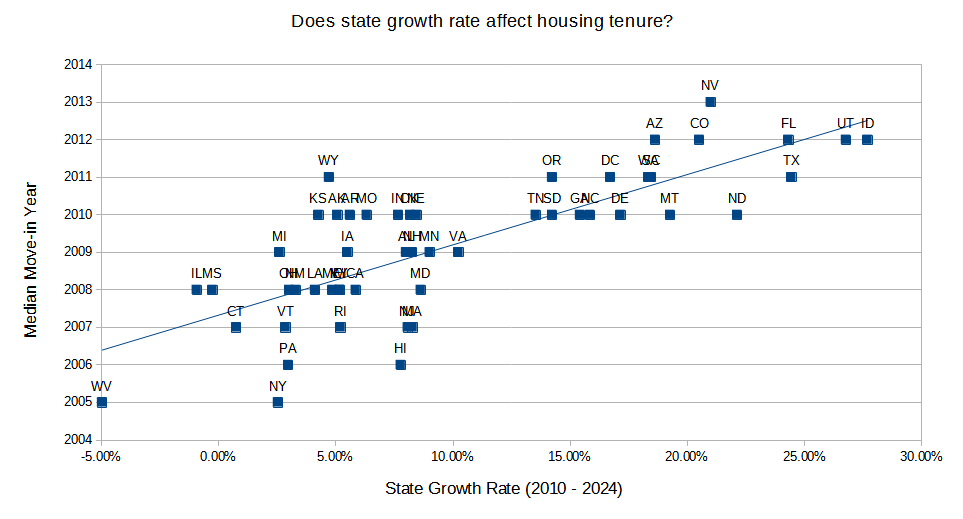
There is definitely a correlation here: states with higher growth rates over the past 15 years tend to have later average move-in dates. The r2 is 0.6, so correlation is pretty strong.
As I mentioned earlier, the census provides more than just the median move-in year; it also provides counts for a series of date ranges:
- Moved in 2021 or later
- Moved in 2018 to 2020
- Moved in 2010 to 2017
- Moved in 2000 to 2009
- Moved in 1990 to 1999
- Moved in 1989 or earlier
Let’s look at states that are at the extremes of some of these categories. For example, who has the highest percentage of homeowners who moved in in 1989 or earlier? It’s Hawaii, with 22.5%. That’s right, nearly a quarter of Hawaiian home owners have lived in their house for at least 35 years. Why? No single reason; some web searching provides these theories:
- It is hard to build new homes in Hawaii (land scarcity, building costs), so people tend to stay put
- There aren’t as many newer buyers – a high percentage of young people leave the state
- There is a cultural tendency toward multi-generational living, which means homes tend to stay in the family.
On the other end of the spectrum, only 3.8% of Nevada owners have lived in their house since 1989. Part of this is just a growing population (22% in the past fifteen years) and Las Vegas sprawl (tons of new suburban homes in the past few decades). And historically Nevada has been a transient state, with 73% of residents not born there.
If Hawaii and Nevada are the outliers, which state is the most typical? In other words, which state’s move-in distribution matches the country as a whole? The winner is Alabama:
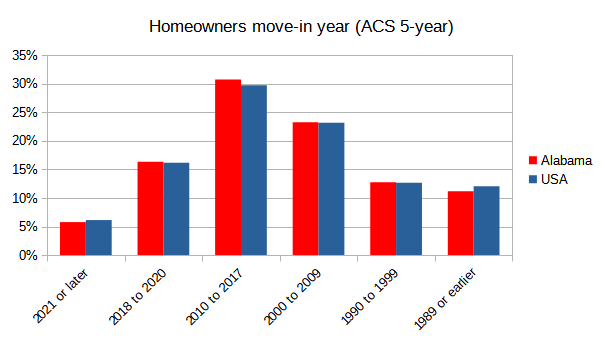
Go figure. There’s no obvious explanation. It’s a relatively poor state, so that makes you think homeowners would stay in one place. On the other hand, real estate is inexpensive, so buying a home is easier in that sense. Maybe those two things cancel each other out. Sigh; it’s a lot easier to figure out why someone doesn’t fit the norm, then why they do.
Next time we’ll dive into lower-level geographies, like counties and census tracts.
