
I recently went in for a blood draw. After they called me back to the lab, the phlebotomist confirmed my identity by asking my last name and date of birth. That got me thinking. What if someone else with and identical last name and date of birth also had scheduled their labs at a similar time? Then a mix-up could happen: Person A gets called into the lab, but the phlebotomist has the orders for Person B (same last name and birthdate). Minutes later, a different phlebotomist calls Person B into the lab, but uses the orders for Person A. Unlikely, sure, but what are the actual odds of this happening?
The probability of two people having the same birthday (e.g., April 29th) are roughly 1 in 365. More accurately, 1 in 365.44, because of leap year days.
Deep Dive: Why 365.44?
In a given four-year period, there are 1461 days (365+365+365+366). For everyone born on days other than February 29th, the odds of matching a birthday with a random stranger are 4 in 1461, or 1 in 365.25. But for the leap year person, the odds are 1 in 1461. This stretches the overall odds to 1 in 365.43759, rounded to 365.44.
But of course they don’t just ask for your birthday, they want the year of birth too. What are the odds of two random people being born in the same year? To determine this, we need to know the distribution of people by age (which is effectively the year of birth). The US Census Demographic Analysis generates an estimate of this information in this table. It does so using current and historical birth and death records, data on international migration, and Medicare enrollment records. Using this table, I calculated he odds of two random people having the same birth year: 0.01178, or about 1 in 84.87. Multiplying this by the birthday odds, we find that the probability of two people having identical dates of birth are about 1 in 31,013.
Deep Dive: Why not just use the 2020 census?
You may be wondering why I used an estimate of the age distribution of Americans. Instead of an estimate, why not just use the full data from the 2020 census? The decennial census counts every person in the country, and includes their year of birth. Wouldn’t it be more accurate to use this data?
Surprisingly, no. The full census suffers from what is known as “age heaping”. The problem arises because the decennial census really tries to count every person. If a household doesn’t respond to mail, email, or even an in-person census taker, then the census bureau tries to get information from some other nearby person (e.g., neighbor, landlord, building manager). This person can probably identify the correct number of persons in the household in question, but they may have to estimate their ages. When people estimate someone’s age, they often round to the nearest 0 or 5 (e.g., 25, or 40). The full census contains enough of these age estimates that it results in unrealistic distribution of ages, exemplified by the sawtooth pattern here (the spikes are all ages that end in 0 or 5):
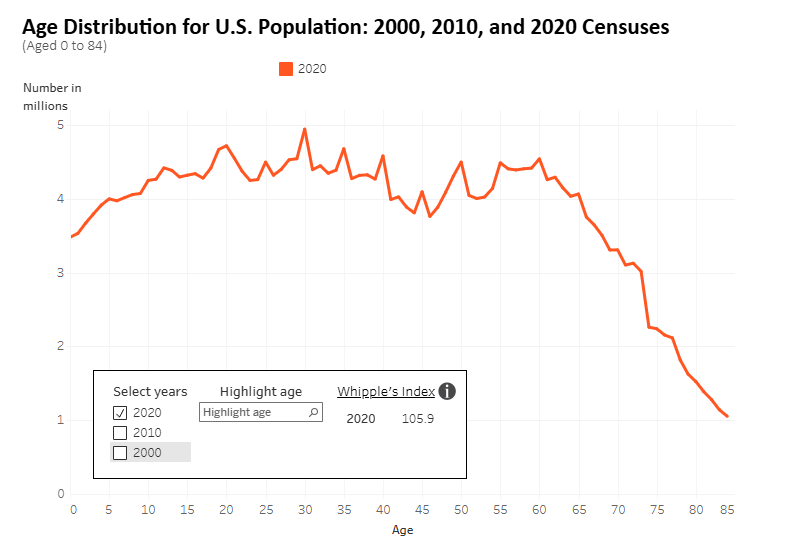
So the full census age data is actually less accurate than an estimate that smooths out the sawteeth. Here’s a full discussion of age heaping, including Whipple’s Index (love the name).
Okay, now on to last names. The 2020 US Census provides a remarkable list of most frequently occurring last names in the 2020 census. This ranges from the most common, “Smith”, with 2,369,644 people of that name, all the way down to the 156,620th, “Drewno” (there are 92 of those). Below that, they just bunch them all together as “All Other Names”. From the distribution in this list, I calculated the chance that two random individuals have the same last name: 0.052327%, or 1 in 1911.
So now we just multiply the chance of having the same date of birth (1 in 31,013) by the chance of having the same last name (1 in 1911). The final answer: 1 in 59,265,843.
Now, the number could be a little lower depending on demographics. For example, in a heavily Hispanic region, there might be a high concentration of the most popular Hispanic names (Garcia, Rodriguez, Martinez, Hernandez, etc), making a name clash more likely. And age distribution changes from area to area (e.g., retirement communities). So instead of 1 in 60 million, the actual odds might be a little lower. But still, it ain’t likely.
Which means whoever came up with those two questions got it just right. They a) are two simple questions that everyone knows the answer to, and b) result in a massively-high probability that you’ve got the right person.
But still, there are a lot of blood draws everyday in the US, so a coincidence might still happen from time-to-time. The frequency of coincidences depends on how many blood draws there are. I’ll estimate that using two different techniques.
- Start with the number of phlebotomists in the US (137,000). Multiply by the number of blood draws they do per day (29 is the average of two sources). Multiply the typical number of working days in a year (240). That computes to 953 million draws a year.
- In 2017, Medicare paid for approximately 233 million blood tests. Medicare covers about 20% of the population; that works out to (233 / 0.2) = 1,151 million draws per year.
These two estimates are reasonably close; I’ll do a rough average and conclude that there’s a nice, round 1 billion blood draws a year.
A billion blood draws a year, and 60 million-to-1 odds of matching a name and DOB. That works out to about 17 times a year when you would expect the coincidence to happen.
Except, there’s one more check. When they call you back for the draw, they use your first name. Then they confirm your last name and date of birth. So in reality, your first AND last names AND your date of birth would have to match. Using the same Census name data, I can roughly calculate the probability of two first names matching: 0.00158, or 1 in 634. So the 60 million-to-1 odds grows to 38 billion to 1. Given a billion blood draws a year, an exact match might happen once every 38 years or so. So basically, “never”.
Finally, what are the odds of randomly coming across your name-and-date-of-birth doppelganger? Of course, it depends on your specific circumstances. I’ll do the most common case. Most common first name: Michael. Most common last name: Smith. Most common birth year: 2000. Most common birthday: anything but February 29th. Odds of matching a random person with these same characteristics: 1 in 278 million1The math: Michael (1 in 86.87), Smith (1 in 126.14), born in 2000 (1 in 69.65), birthday (1 in 365.25). Multiply these together: 1 in 278 million. Even in the most common case, it’s extremely unlikely.
